Friday, 27 April 2012

A Dirty Weekend in Paris, with beer

"Here are the keys", he said. "I changed the sheets on the sofa bed and now I am off  to the South of France. See you next week." And with that we found ourselves alone in a 'Cute little apartment in the best district of Paris'.

We didn't know him from Adam but his name was Frederic. His food was in the fridge, his dirty washing was in a pile in the bathroom. There was a ring of dirt around the bath. No vacuum cleaner (though there was a pipe from one) not even a dust pan and brush. All the wardrobe doors were bike-padlocked up. Just two drawers to put our stuff in. There was more but I won't bore you. Mmmm. Cute.


But it certainly was central; the 1st Arrondissement. The Louvre and Notre Dame were just a few streets away. The Gothic gargoyles and flying buttresses of the Eglise Saint Eustache loomed over us as we looked out of our first floor windows. The street was quiet and the windows double-glazed, although the Pompiers de Paris had their station literally next door. Fortunately they don't put the siren on until they leave the street.

It was a rainy week and not quite the Springtime in Paris we had hoped for. We were grumpy at first but, for me at least, Paris began to get under my skin. I was warming to it's history and grandeur as the days passed. We walked the streets of the Marais, the Latin Quarter, walked around the Louvre, visited the Tour Eiffel (but didn't inhale go up it on account of the queues for the one serviceable lift). We ate a lot of cakes. Then, just as I was about to walk past it, Mrs Brewer saw a beer shop, a very special beer shop. Le Cave a Bulles. Proprietor Simon Thillou was happy to talk about beer and was delighted to hear that I was opening a brewery. Maybe I would bring him some when we were in production? Sounds like a good idea.


Also in the shop was Simon's American friend Jordan. "Don't buy the Mikkeller 'It's Alive'. This is better. If you only buy one, buy this" and he handed me a different Mikkeller beer. At €34 it ****** **** ought to be good. I looked at Mrs Brewer. "Go on then", she said. So I became the owner of the most expensive bottle I have ever bought. I don't suppose I can put it down as a business expense but it was certainly good research for where I need to go with Poppyland Brewery. These are the leaders and the competition.

It didn't disappoint. The Mikkeller Nelson Sauvignon is a very special beer. It was plastic corked and muzzled in a sensibly brown 750 ml champagne bottle, 9% abv and it had a wonderful deep orange amber colour. The aroma just climbed out of the glass, powerful, citrus orange from the New Zealand Nelson Sauvin hops. I knew what was coming: it was going to be big. Yep. It was. A lovely foaming white head developed as it was poured, sinking gradually to a persistent ring and lacing. The first taste was huge, stacked full of fresh citrus, orange peel, Cointreau, yeasty, bitter-sweet, cidery, gorgeous, more-ish. The aroma was still there an hour later, huge, bursting. I had never had a beer like it, now smelling of fresh tea and autumn leaves in warm sunshine. This was all balanced by good malt but really, it was the hops and the gentle brett that were the stars. Ooooh! Exquisite. A tiny sip just filled the mouth. Its three months in the Austrian wine cask had certainly been time well spent. That bottle kept me entertained for the rest of the evening as I read the excellent and stimulating resource book for brewers, 'Radical Brewing' by Randy Mosher. I won't forget that evening. €34 well spent and cheaper than a disappointing 2008 Chinon that we drank at Les Papilles later that week. The food there was good, but not such good value for money as lunch at the restaurant of Alain Ducasse at the Dorchester on Mrs Brewer's birthday. It's all about the difference between cost and value for money.

By the way, in London on the way home, I visited Cask and Kitchen's Pimlico joint and there I found Mikkeller's 'It's Alive' on tap, all-be-it on top pressure. It didn't disappoint either, but it was rather cheaper, £4.60 a half if I recall. It's a busy establishment but very good for craft beer. Go there.

Charles Babbage's Brain

When I heard James Gleick on Radio 4 he immediately commanded my attention. In conversation with his interviewer his relaxed tones had authority and I knew I had to read his newest book, The Information: A History, A Theory, A Flood (Fourth Estate, London 2011). I ordered it from Amazon and waited expectantly for its UK publication.

When the heavy paperback arrived I devoured its contents. The Information connected so many strands of my life, information science and the IT revolution that has been going on around us for several decades now. Gleick writes with clarity and insight and I would recommend it to anyone that is interested in how the modern world ticks, running as it increasingly does on pure information, coursing through its electronic nervous system.

Gleick devotes a fair amount of space to the nineteenth century mathematician Charles Babbage (1791-1871) and his far-sighted ideas about pure information which were embodied in his Difference Engine and its more advanced successor the Analytical Engine, a design for the world's first programmable computer. I was also introduced to, and rather captivated by, the precocious talent of his young pupil Ada Lovelace (nee Byron) who is credited with conceiving and actually writing the world's first computer program. She was an insatiable mathematical thinker and very sure of her own abilities, nor shy of telling everyone so.

Babbage had an amazing brain which he used to solve numerous problems in his lifetime by rigorous analysis and the application of logic. He was also a great London socialite and though he held the Lucasian chair of Mathematics at Cambridge (a post held by Isaac Newton no less) he was not required to attend the university very often and so he remained free to pursue his curiosity wherever it led him.

Imagine how captivated I was then to come face to face, so to speak, with all that remains of Charles Babbage. Well almost face to face. For in an exhibition at the Wellcome Collection, suspended in a numbered glass jar, was the pickled left hemisphere of Charles Babbage's brain. I looked and looked, transfixed. It seemed a good size but not exceptional. The preparator had severed the two hemispheres through the brain stem and the knife had strayed off course, cutting into a fold in his cerebral cortex. What damage might that have inflicted had Babbage been alive! What path might the history of information science taken without the insights conceived in that colossus of an intellect that inhabited those delicate folds in this organ before me?

Such is the power of museum collections to connect and such was my amazing good fortune to have stumbled upon this artefact, while waiting for my appointment at the eye hospital along the road. I just love serendipity. By another coincidence Babbage also invented the opththalmoscope, a device which allows surgeons to see inside the eye but like his early mechanical computers his invention was forgotten and had to be independently invented by Helman von Helmholtz. I found myself seated before a modern version of one later that afternoon.

Seek out and your luck comes to you.

Monday, 9 April 2012

A surreal mammoth moment

The new season of my Geology Walks at West Runton (Norfolk, UK) began yesterday, which was Easter Sunday and I had a party of 23. There is a wealth of geology to see in this small compass but the highlight for most would be the grave site of the West Runton Mammoth, discovered in 1990 and excavated 1990-1995. This was an extremely well preserved skeleton (85% complete) of a large bull of the ancestral species, the Steppe Mammoth (Mammuthus trogontherii). It died in its prime at the age of 41 and its cadaver was eaten by hyaenas (Crocuta crocuta), their characteristic tooth marks being evident of the bones. Many of the smallest bones were missing, removed presumably by the hyaenas and there was evidence of a serious subluxation (displacement) of the knee joint with which the creature had survived for some months before succumbing.

A group on my West Runton Geology Walk on 30 August 2011 -
all ages and capabilities are catered for!

This is Britain's oldest and most complete mammoth fossil. Imagine my surprise and delight then when, as I was about to launch into a spiel about larvikites, I was hailed by a voice from afar. It was my old friend and colleague Professor Tony Stuart, who directed the excavation of the West Runton Mammoth. "Martin, good to see you. I'd like to introduce you to Dr Sergy Vartanyan and his partner Diana." I smiled politely and shook hands. "He published the discovery and radiocarbon dating of the relict population of mammoths on Wrangel Island". I stepped back in honour and amazement, beamed, took off my hat and bowed. Well you would.

It was widely believed that all trace of the woolly mammoth (Mammuthus primigenius) had disappeared by 9,500 BP, the victims of environmental changes at the Pleistocene-Holocene boundary, or by hunting pressure from humans, or both. But in 1993 Vartanyan and his colleagues demonstrated that the population of Wrangel Island, in the Arctic Ocean, had lived on, as they had found teeth dating between 7000 and 4000 BP. Mammoths almost made it into modern times. He also discovered that they were very small (180 - 230 cm shoulder height) on Wrangel, not 'mammoth' at all. Compare this with the West Runton Mammoth, estimated to have been 400 cm.

Where is Wrangel Island? Well, at West Runton we were just 84.2 km to the east of the Greenwich or Prime Meridian (the line of 0 degrees longitude). If you follow it northwards you pass between Greenland and Svalbard and on to the North Pole. At this point you are somewhere in the middle of the Arctic Ocean. Beyond the pole the line is called the Antimeridian. Keep going until you approach the northern coast of eastern Siberia. Before you get there the Antimeridian bisects Wrangel Island. It is 6,231 km away from Runton 'as the crow files' - assuming they fly by the great circle route. You can see where Wrangel is in this picture of Sergy and Diana in their St. Petersburgh apartment (courtesy of Tony Stuart). It is close to the top edge on the top right hand side.


It was a great honour to have the scientists who worked on the oldest mammoths and the youngest mammoths making a guest appearance on my Geology Walk!

Sunday, 1 April 2012

J.W. Lees Harvest Ale 2000

Limited edition 1 December 2000.

11.5% 275 ml bottle, crown corked.

I am celebrating the completion of the Poppyland Brewery drain. There were 5 days of traffic lights and delays in central Cromer but in the end it all went very smoothly. Tomorrow the new floor screed goes down.

I bought this little bottle of J.W. Lee's Harvest 2000 Ale, bottle conditioned, for £3.00 at a sale in Southrepps Village Hall (North Norfolk) last summer so I thought it was time for a libation in celebration and to placate the Trade Effluent Gods. As I poured this unctuous ale into a small stemmed glass it built a nice creamy head, then subsided to a ring in a minute or so. Thrusting in a nose there was a powerful, strange aroma of very aged malt. Against the light it looks dark red but it is very dark in the glass. The first taste was very sweet but malty (it was the first of the 2000 harvest of Maris Otter). Those East Kent Goldings died away years ago, so it had no real bitterness. The powerful greeting on the nose was not evident on the tongue. The flavour was dominated by cloying sweetness; so sweet in fact it that made my lips sticky. But the malt flavour lasted long after the sweetness has gone down the throat.  Considering how much alcohol there was it was very well behaved.

Has it been worth the wait – after 11 years and 4 months? Well, no not really. It was OK, but I wouldn’t rave about it. It’s certainly better than Gold Label barley wine, but not as much as it should have been. I can’t think there was much development after the first month or two. Why was it not drier after all this time? Either J.W. Lees’ ‘excellent Cervisiae’ yeast had given up the ghost in all that alcohol or the sweetness was down to dextrins, which cannot be fermented by ordinary yeast. So this beer has been in a state of suspended animation for over a decade and not getting any better. There's a lesson then.


I'll have another tipple now but the next one will be Humpty Dumpty's Christmas Crack 7%. We had a firkin of it last Saturday (a 60th birthday present from Mark and Neil - brill and thanks you guys). I bottled some off, just in case we didn't drink it all (and we didn't!). I'll tell you about the Humpty Dumpty Experience one day soon.

Friday, 30 March 2012

Ales Gas 'n Lager

When I noticed that the sign over the shop window was made of screwed-on plastic letters it reminded me of Fawlty Towers. I could move them around, I thought and save myself a few bob. So that's how ALLEN'S GARAGES in West Street, Cromer became ALES GAS 'N LAGER. That just about sums up the future output of my proposed POPPYLAND BREWERY. The gas of course has nothing to do with the effects of too much beer on your digestion but everything to do with the by-products of fermentation. As are real ales and lager of course.


Among beery aficionados lager has earned itself a deservedly poor reputation in Britain for the ultra-cold, insipid, gas-laden yellow liquid that spurts from keg taps the length and breadth of the country. Ubiquitous, bland and over-priced. Some people seem to like it but do they have any idea what real lager should taste like? And that there used to be black lagers and flavour-some lagers and all kinds of different lagers besides Pilsners, stored for months in cold cellars and caves before coming to perfection and being released by the proud brewer to quench the thirst of a grateful public?

When I eventually do brew beer for sale I want the drinker to think, Wow! That's extraordinary. A different drinking experience and worth every penny.

Wednesday, 28 March 2012

Lucky breaks

The building work on the brewery has moved on a massive step this week. We have our very own hole in the road, complete with 4-way traffic light system. Don't try this at home folks. It's very expensive but it has to be done to get drainage into the brewer and get a flue liner up the chimney. Our apologies to our neighbours, the good people of Cromer and travellers for the noise and delays.


Mackinnon Construction sent down a great team, including three Pauls-in-a-pod, all in identical orange overalls and all with shaved heads: Paul Newton, Paul Kelly and Paul Fulcher.


We have been blessed with brilliant weather, which always helps but yesterday two strokes of luck helped the project on it's way. Firstly a problem with a jackdaw's nest in a crank in the chimney prevented Swiftair from completing the new flue lining.


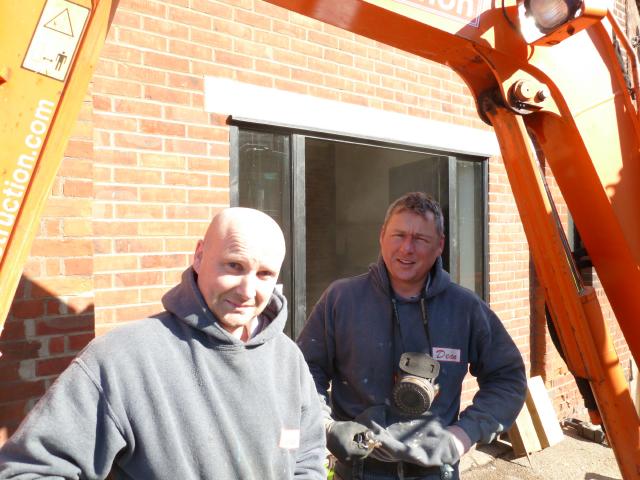
A frantic call to two local chimney sweeping firms found one of them busy and the other one not answering the mobile. I left a message and set about trying to find a solution to clearing the flue. A few minutes later a call came in. It was the Dean Knowles the chimney sweep from Woodburners of Gresham. He had been in Overstrand and out of signal range. But as he was coming through Cromer he found himself sitting in a queue of traffic, waiting to go through some traffic lights where the road was up. He checked his voice mails while he waited and got my desperate message. He was actually queuing at our very own traffic lights: how lucky is that? He came straight on site and in no time he and his colleague - another Dean! - had the chimney cleared of sticks and the brush poking triumphantly out of the chimney pot.


  Dean Knowles (right) and Dean Patrick his assistant. Thanks guys.


So Swiftair could get on, completed their flue lining and all was well. The second stroke of luck came when the Mackinnon digging team, having picked their way carefully around numerous buried services - power cables, phones, water main, gas pipe and old sewer - eventually found the main sewer running down the middle of the street at 2 metres depth. To everyone's astonishment they found that the Victorian constructors had provided a junction ready for us to connect straight into the sewer, so no cutting was needed. How lucky was that? Our hole had landed right on it, purely by chance, or maybe it was providence.

It just seems that this project was meant to be and that's not the first time I have said it. Someone or something seems to be guiding events and it is shaking my atheistic beliefs to the core.

Monday, 26 March 2012

A Terrible Beauty is Born

I brewed my first beer when I was 18. That was in 1970 and I remember it well. The 'copper' was just a large pan on the gas cooker and the fermentation vessel was my mother's old green plastic bucket that she kept around the kitchen. Heaven knows what had been in it before: coal, nappies, whatever. It was one of those so-called dry kits that you could buy from Boots. There were crystal malt grains and hops in a mesh bag and I am sure there must have been some malt extract. Maybe it was dried, can anyone recall? I don't know if you were supposed to add sugar as well but I think I did, because the strength of that beer sent me reeling. It was highly effervescent and it was bottled off into those quart-sized cider bottles with the black compound stoppers and red rubber sealing rings. I had those for years.

I didn't brew at university but when I had settled in Norfolk I took it up again for a few years while the kids were young, with slightly better equipment but still using brew kits. It was only in 2008 that Mrs Poppyland Brewer splashed out on a new kitchen at Poppyland Towers and all those smooth black kitchen surfaces and a larger-than-life electric hob got me thinking that I should put it all to good use and start brewing again. So I bought some basic equipment and a beer kit or two and started afresh. I had had the foresight to install a pull-out table that fitted into a drawer unit and that made an ideal racking stillage, with beer (and wine) being syphoned off the work-surface to the receiving vessels on the pull-out table below. After a few brews to get my eye back in I decided to move on to whole grains and started using Brupac's kits but soon I was making up my own recipes and exploring the ingredients that brewers have at their disposal - malts, hops and of course various yeasts. I have never looked back really.

I stumbled upon Brendan Moore and the East Anglian Brewers' Cooperative by chance after a museum meeting in Thetford. I detoured via the Iceni Brewery in Ickburgh in the hope of buying some ingredients and one or two items of equipment. It was late in the day but I found Brendan there - on the phone as usual - and when he got off the phone I mentioned that I had received my redundancy notice and was considering going in to brewing. Well, two hours later I felt I had taken up enough of Brendan's time but he had drummed into me that I would be a fool to start up brewing in the same way that he had done and the same way that most of the other brewers in Britain were still doing. It was a mug's game. But if I explored a different model - brewing less beer but better beers like the Americans and Italians there was a chance of making a go of it. Don't borrow money, he said. Start with what you can afford; don't brew too much beer and don't go selling it cheap.

After more than a year of training, experimenting, travelling, visiting breweries and working with brewers I find myself collaborating with Brendan in his Extraordinary Ales project. He asked me to supply rocks for a hot rocks experiment and to calculate the thermodynamics of throwing hot rocks (and later on hot rivets) into wort in order to generate a caramelising super-boil. I did some experiments in my kitchen and watched the heat transfer, making neat little graphs for various temperatures of rocks. We collaborated on a real brew at his Elveden brewhouse and dropped hot rocks into wort. It worked. The wort didn't leap into the air and scald the brewers to death as some had feared. It did the job very well and having just tasted the fermented result from one of the gyles I can declare the experiment a whole-hearted success.


On 19th March a demonstration was given at a 'Slow Brewing' training day for the East Anglian Brewers. We had the resources of the Fransham Forge to help us and 18 kg of large rivets were heated in a furnace. This was much hotter than I ever imagined. There was also an unexpectedly long boil (don't ask why) and about a third of the 100 litres wort had boiled off before the rivets went in. The super-boil certainly was spectacular and there wasn't much wort left but I think the resulting flavour changes are going to be profound. And so this first Extraordinary Ale is now fermenting. In a thinly veiled nod to Irish Republicanism, his beer will be named from a line that is repeated at the end of each stanza in W.B. Yeats' poem about the uprising - Easter 1916 - and 'A Terrible Beauty is Born'.


Last two images are lifted from some excellent video footage shot by Adam Jackson.