Friday, 30 March 2012

Ales Gas 'n Lager

When I noticed that the sign over the shop window was made of screwed-on plastic letters it reminded me of Fawlty Towers. I could move them around, I thought and save myself a few bob. So that's how ALLEN'S GARAGES in West Street, Cromer became ALES GAS 'N LAGER. That just about sums up the future output of my proposed POPPYLAND BREWERY. The gas of course has nothing to do with the effects of too much beer on your digestion but everything to do with the by-products of fermentation. As are real ales and lager of course.


Among beery aficionados lager has earned itself a deservedly poor reputation in Britain for the ultra-cold, insipid, gas-laden yellow liquid that spurts from keg taps the length and breadth of the country. Ubiquitous, bland and over-priced. Some people seem to like it but do they have any idea what real lager should taste like? And that there used to be black lagers and flavour-some lagers and all kinds of different lagers besides Pilsners, stored for months in cold cellars and caves before coming to perfection and being released by the proud brewer to quench the thirst of a grateful public?

When I eventually do brew beer for sale I want the drinker to think, Wow! That's extraordinary. A different drinking experience and worth every penny.

Wednesday, 28 March 2012

Lucky breaks

The building work on the brewery has moved on a massive step this week. We have our very own hole in the road, complete with 4-way traffic light system. Don't try this at home folks. It's very expensive but it has to be done to get drainage into the brewer and get a flue liner up the chimney. Our apologies to our neighbours, the good people of Cromer and travellers for the noise and delays.


Mackinnon Construction sent down a great team, including three Pauls-in-a-pod, all in identical orange overalls and all with shaved heads: Paul Newton, Paul Kelly and Paul Fulcher.


We have been blessed with brilliant weather, which always helps but yesterday two strokes of luck helped the project on it's way. Firstly a problem with a jackdaw's nest in a crank in the chimney prevented Swiftair from completing the new flue lining.


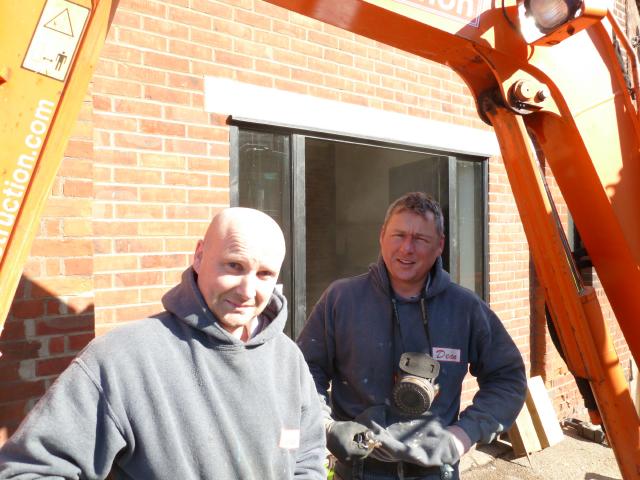
A frantic call to two local chimney sweeping firms found one of them busy and the other one not answering the mobile. I left a message and set about trying to find a solution to clearing the flue. A few minutes later a call came in. It was the Dean Knowles the chimney sweep from Woodburners of Gresham. He had been in Overstrand and out of signal range. But as he was coming through Cromer he found himself sitting in a queue of traffic, waiting to go through some traffic lights where the road was up. He checked his voice mails while he waited and got my desperate message. He was actually queuing at our very own traffic lights: how lucky is that? He came straight on site and in no time he and his colleague - another Dean! - had the chimney cleared of sticks and the brush poking triumphantly out of the chimney pot.


  Dean Knowles (right) and Dean Patrick his assistant. Thanks guys.


So Swiftair could get on, completed their flue lining and all was well. The second stroke of luck came when the Mackinnon digging team, having picked their way carefully around numerous buried services - power cables, phones, water main, gas pipe and old sewer - eventually found the main sewer running down the middle of the street at 2 metres depth. To everyone's astonishment they found that the Victorian constructors had provided a junction ready for us to connect straight into the sewer, so no cutting was needed. How lucky was that? Our hole had landed right on it, purely by chance, or maybe it was providence.

It just seems that this project was meant to be and that's not the first time I have said it. Someone or something seems to be guiding events and it is shaking my atheistic beliefs to the core.

Monday, 26 March 2012

A Terrible Beauty is Born

I brewed my first beer when I was 18. That was in 1970 and I remember it well. The 'copper' was just a large pan on the gas cooker and the fermentation vessel was my mother's old green plastic bucket that she kept around the kitchen. Heaven knows what had been in it before: coal, nappies, whatever. It was one of those so-called dry kits that you could buy from Boots. There were crystal malt grains and hops in a mesh bag and I am sure there must have been some malt extract. Maybe it was dried, can anyone recall? I don't know if you were supposed to add sugar as well but I think I did, because the strength of that beer sent me reeling. It was highly effervescent and it was bottled off into those quart-sized cider bottles with the black compound stoppers and red rubber sealing rings. I had those for years.

I didn't brew at university but when I had settled in Norfolk I took it up again for a few years while the kids were young, with slightly better equipment but still using brew kits. It was only in 2008 that Mrs Poppyland Brewer splashed out on a new kitchen at Poppyland Towers and all those smooth black kitchen surfaces and a larger-than-life electric hob got me thinking that I should put it all to good use and start brewing again. So I bought some basic equipment and a beer kit or two and started afresh. I had had the foresight to install a pull-out table that fitted into a drawer unit and that made an ideal racking stillage, with beer (and wine) being syphoned off the work-surface to the receiving vessels on the pull-out table below. After a few brews to get my eye back in I decided to move on to whole grains and started using Brupac's kits but soon I was making up my own recipes and exploring the ingredients that brewers have at their disposal - malts, hops and of course various yeasts. I have never looked back really.

I stumbled upon Brendan Moore and the East Anglian Brewers' Cooperative by chance after a museum meeting in Thetford. I detoured via the Iceni Brewery in Ickburgh in the hope of buying some ingredients and one or two items of equipment. It was late in the day but I found Brendan there - on the phone as usual - and when he got off the phone I mentioned that I had received my redundancy notice and was considering going in to brewing. Well, two hours later I felt I had taken up enough of Brendan's time but he had drummed into me that I would be a fool to start up brewing in the same way that he had done and the same way that most of the other brewers in Britain were still doing. It was a mug's game. But if I explored a different model - brewing less beer but better beers like the Americans and Italians there was a chance of making a go of it. Don't borrow money, he said. Start with what you can afford; don't brew too much beer and don't go selling it cheap.

After more than a year of training, experimenting, travelling, visiting breweries and working with brewers I find myself collaborating with Brendan in his Extraordinary Ales project. He asked me to supply rocks for a hot rocks experiment and to calculate the thermodynamics of throwing hot rocks (and later on hot rivets) into wort in order to generate a caramelising super-boil. I did some experiments in my kitchen and watched the heat transfer, making neat little graphs for various temperatures of rocks. We collaborated on a real brew at his Elveden brewhouse and dropped hot rocks into wort. It worked. The wort didn't leap into the air and scald the brewers to death as some had feared. It did the job very well and having just tasted the fermented result from one of the gyles I can declare the experiment a whole-hearted success.


On 19th March a demonstration was given at a 'Slow Brewing' training day for the East Anglian Brewers. We had the resources of the Fransham Forge to help us and 18 kg of large rivets were heated in a furnace. This was much hotter than I ever imagined. There was also an unexpectedly long boil (don't ask why) and about a third of the 100 litres wort had boiled off before the rivets went in. The super-boil certainly was spectacular and there wasn't much wort left but I think the resulting flavour changes are going to be profound. And so this first Extraordinary Ale is now fermenting. In a thinly veiled nod to Irish Republicanism, his beer will be named from a line that is repeated at the end of each stanza in W.B. Yeats' poem about the uprising - Easter 1916 - and 'A Terrible Beauty is Born'.


Last two images are lifted from some excellent video footage shot by Adam Jackson.

Thursday, 20 October 2011

Hops and Glory

I am just reading Pete Brown’s light-hearted history of India Pale Ale, which he interleaves with the story of a barrel of beer travelling the old fashioned way by ship (well most of it by ship) from Burton-on-Trent to India. There is little about hops but it is a good read. 

What an extraordinary year it has been, weather-wise. The marvelous March sunshine advanced the spring but that was followed by a drought in April, May and June. This lasted 43 days in North Norfolk and was devastating for the elderflowers. They shrivelled and turned brown and blackberries didn't flower as they should either. When the drought broke and summer progressed many trees and plants flowered a second time. Magnolia for instance came back into flower in high-summer, Bergenia too. The drought had sent them into suspended animation and on re-awakening they thought spring had arrived a second time.
Wild hops at Upper Sheringham, Norfolk

Whatever it has done for other flowers, this summer has been great our local wild hops. I noticed them all over the place in September and I eagerly anticipated the harvest. For the past couple of years I have gathered wild hops from the hedgerows at Upper Sheringham and used them as an adjunct to my home brewing. Cultivated hops are expensive but these are free. I like the idea of using wild hops, even though their flavour and bitterness can be unpredictable. I reckon if I get to know their properties, then using local wild hops promises a truly local, zero kilometre ale. As I am using North Norfolk malt from Branthill Farm, adding North Norfolk hops seems only natural.

One thing I have noticed: you don’t see hops out in the open countryside. They are most commonly found in or around old villages, especially those with ancient pubs. Furthermore, here in North Norfolk many villages have monastic ruins and I have often found hops close to the old priories – at Walsingham, Binham, Weybourne, Beeston Regis, Castle Acre and Newton by Castle Acre to name a few. What’s more, several of these hop bines boast cones up to 50mm long; their aromas are good too, so these are clearly not the pure wild variety, but cultivars. I gathered several kilograms in late September and early October, keeping careful note of where each batch came from. I air-dried them in the embryonic Poppyland Brewery, bagged and froze them, ready for use through the winter. I shall be brewing with them soon.
A golden hop variety at Binham, Norfolk.

In the medieval period monasteries such as Walsingham Priory grew rich on receiving pilgrims, who came to worship at the shrine. Other monasteries offered food and shelter to travellers and the monks brewed beer for guests and for themselves. So it is quite likely that some of the hops I have gathered are descended from plants that escaped from the monk’s hop yards. Others may be from the days when hops were not available by mail order and publicans were brewers, so they grew their own.


Tuesday, 20 September 2011

Brewing in Allen's Garage

After looking far and wide at farm buildings and industrial units I think I may have found somewhere suitable for brewing.  Almost next to my house, Allen's Garages has been demolished and will be redeveloped into flats. But a small part of the original 1906 building remained and was just begging me to use it as a microbrewery.

I only ever intend to be a one-man-band, so it is ideal. I can pop in and out as I please, fussing over things and making really extraordinary ales. There are numerous hurdles to negotiate before I can say it's mine but the signs are encouraging.
In May I used the shop window to publicise my presence and word rapidly spread that a new brewery is in the offing. People are asking when there will be any beer. Well hold your horses folks, not for months yet! There are many things to get in place - and it may yet not happen at all if it proves to be too difficult or too expensive to convert the garage to a brewery.
There is little sign that the place has been cleaned since 1906 and there is a wonderful smell of 'old garage'. Soon I hope it will be filled with the smell of wort boiling and the sound of bottles being filled.


Its a dirty job but someone has to do it.